
The Complete Guide to ELT Teaching in 2025 | Modern Methods, Materials & Tools

The Complete Guide to ELT Teaching in 2025

Introduction

Teaching English in 2025 looks nothing like it did even five years ago. Classrooms are larger, attention spans are shorter, and students expect lessons that feel modern, interactive, and connected to their real lives. At the same time, AI tools, digital learning platforms, and new global ELT standards are pushing teachers to adapt rapidly.

This guide gives teachers a complete, practical roadmap for succeeding in today’s ELT environment. Whether you teach young learners, teens, or adults, you’ll find frameworks, strategies, and tools designed to improve lessons, increase engagement, reduce planning time, and help students build real communication skills.

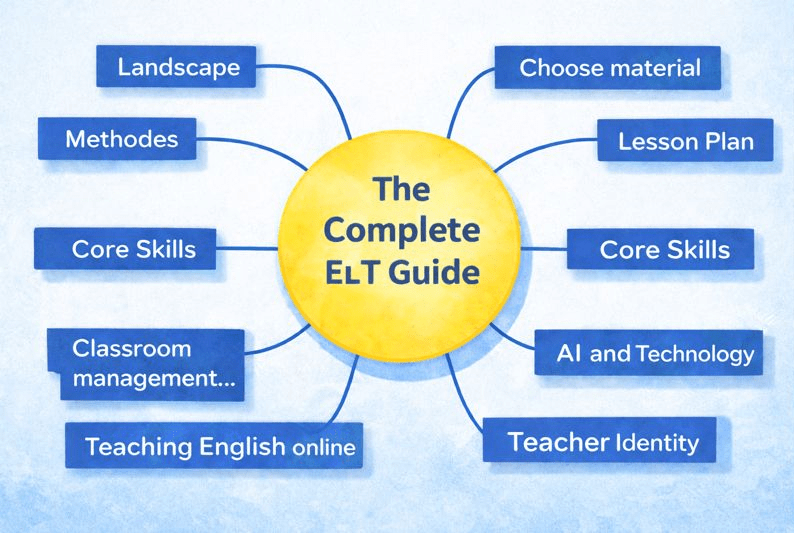
Use this guide to:

  • Understand what changed in ELT and what students expect now.
  • Choose the right books and materials for each age group.
  • Learn the most effective teaching methods in 2025.
  • Plan lessons quickly using proven structures.
  • Teach speaking, reading, and writing with confidence.
  • Manage large or mixed-ability classrooms.
  • Use technology and AI in smart, teacher-friendly ways.
  • Build a strong teacher identity that earns trust.

The ELT Landscape in 2025

Modern English teaching is shaped by shifting student behavior, digital influence, global standards, and rapid changes in how language is used in real life. Here’s what teachers need to understand before stepping into today’s classroom.

👉 For a full breakdown of global ELT changes, visit the complete section: The ELT Landscape in 2025.

What Has Changed in Teaching English

English is no longer taught as a purely academic subject. Students want it for communication, entertainment, study, and online interaction. Key changes include:

1. English Exposure Happens Before the Classroom

Students consume English daily through:

  • YouTube
  • Games
  • TikTok
  • Social media
  • Music
    This means they recognize more vocabulary but expect lessons to feel equally dynamic.

2. Communication Is the Primary Goal

Accuracy still matters, but fluency and real-world application now drive most global ELT frameworks.

3. Skills Are Integrated, Not Isolated

Reading → leads to speaking.
Listening → leads to writing.
Grammar → supports communication.

4. Teachers Need Flexibility

Rigid lesson plans no longer work. Teachers must adapt to energy levels, time limits, mixed levels, and unexpected classroom challenges.


What Students Expect Today

Students in 2025 bring new habits shaped by digital environments.

1. Short, Fast-Paced Activities

Attention spans have dropped — lessons need continuous movement.

2. Immediate, Clear Feedback

Students expect quick corrections and guidance, similar to apps they use every day.

3. Digital Integration

Pictures, videos, audio, and interactive elements are no longer optional.

4. Purpose Behind Every Activity

Students want to know why they are doing something and how it helps their real-life goals.

5. Emotional Safety

Fear of mistakes kills participation. Confidence-building is part of modern ELT.

6. Flexible Learning Experiences

A good lesson mixes:

  • quiet and active tasks
  • pair and group work
  • digital and physical tools

Global Trends Affecting ELT

Several global developments shape how English is taught in 2025:

AI in Learning

AI now supports:

  • pronunciation correction
  • reading and vocabulary practice
  • writing feedback
  • lesson planning
    Teachers must integrate AI without depending on it.

Hybrid Learning

Schools combine classroom learning with online practice, video homework, and digital assessment.

Real-World Skills

Students need English for:

  • communication
  • problem solving
  • collaboration
  • global citizenship
    ELT is shifting toward practical interaction.

Focus on Speaking

Global exams and curricula prioritize fluency and communication over grammar-heavy lessons.


The New Role of Teachers in 2025

Today’s teacher is more than an instructor.

The Teacher as Guide

Teachers help learners navigate challenges and build confidence.

The Teacher as Facilitator

Classrooms are interactive — teachers create conditions for student talk.

The Teacher as Curator

Teachers select the best materials and digital tools, filtering out noise.

The Teacher as Mentor

Emotional support is essential for modern students.

The Teacher as Designer

Effective learning experiences require structure, timing, and clear outcomes.


Section Summary

The ELT world of 2025 demands flexible, student-centered teaching supported by digital tools and real-world skills. Understanding these shifts prepares teachers to plan lessons, choose books, and manage classes with confidence.


Choosing the Right ELT Books & Materials

Selecting the right materials can dramatically improve lesson quality, student motivation, and overall learning outcomes. In 2025, with students expecting visual content, real-life topics, and digital integration, teachers must know how to evaluate and choose books that support modern learning.

👉 Explore detailed guidance on selecting OUP/CUP books and materials here: Choosing ELT Books & Materials.

How to Evaluate ELT Books (Clear, Practical Criteria)

A strong ELT book in 2025 should meet the following criteria:

1. Clear Learning Outcomes

Each unit should state what students will achieve — communicative goals, vocabulary sets, grammar points, and real-life tasks.

2. Logical, Smooth Progression

The difficulty should increase gradually, without sudden jumps that confuse learners.

3. Balanced Skills Practice

Reading, writing, listening, and speaking should be integrated naturally.

4. Strong Speaking & Interaction Tasks

Modern ELT prioritizes communication — books must include authentic speaking opportunities.

5. Relevant and Engaging Content

Topics should connect to students’ age, interests, and real-world experiences.

6. Strong Teacher Support

A good Teacher’s Book includes:

  • step-by-step procedures
  • differentiation suggestions
  • assessment tools
  • extra activities

7. Digital Enhancements

Modern ELT requires tools such as:

  • videos
  • audio tracks
  • interactive homework
  • digital games
  • mobile apps

8. Cultural Sensitivity & Inclusivity

Books must reflect diverse contexts and avoid stereotypes.


OUP vs CUP — Strengths and Use Cases

Oxford University Press (OUP) and Cambridge University Press (CUP) remain leaders in ELT publishing, but each excels in different areas.

OUP Strengths

  • Strong phonics foundation
  • Highly structured progression
  • Teacher-friendly lesson guidance
  • Engaging visuals
  • Series like Family & Friends, English File, Headway

Best for: Younger learners, foundational levels, structured classrooms.

CUP Strengths

  • Critical thinking activities
  • Strong communication focus
  • Academic depth in reading/listening
  • Series like Kid’s Box, Power Up, Unlock, Face2Face

Best for: Teens, adults, exam prep, or communication-focused classes.


Choosing Books for Kids, Teens, and Adults

Kids (Young Learners)

Books should include:

  • visuals
  • songs
  • phonics
  • games
  • short activities

Teens

Materials should feel mature and relevant:

  • projects
  • real-life topics
  • critical thinking tasks
  • communication activities

Adults

Prioritize:

  • workplace English
  • practical communication
  • authentic texts
  • fast-paced grammar explanations

When to Use Phonics Books (and When Not To)

Use phonics books when:

  • learners are beginners
  • teaching ages 4–10
  • decoding and spelling need support

Avoid phonics when:

  • students read fluently
  • teaching teens or adults
  • the focus is communication, not decoding

How to Avoid Poor-Quality or Outdated Materials

Avoid books that:

  • use unnatural dialogues
  • contain outdated visuals
  • lack digital resources
  • focus only on grammar
  • skip speaking tasks

A quick test:
If the book looks older than your students’ phones, it’s time to upgrade.


Digital Resources Teachers Forget to Use

Many teachers underuse digital tools that come with their books.
Look for:

  • unit videos
  • audio tracks
  • grammar animations
  • online games
  • home assignments on apps
  • interactive practice platforms (Oxford Online Practice, Cambridge One)

These tools make lessons more engaging without increasing teacher workload.


Section Summary

Choosing the right materials is one of the most important decisions a teacher makes. Books must support communication, engagement, digital integration, and clear progression. With the right materials, both teachers and students experience smoother, more effective lessons.

Teaching Methods That Work in 2025

Modern ELT requires flexible, student-centered methods that build real communication skills. This section covers the most effective teaching approaches used globally in 2025 — with clear explanations teachers can apply immediately.

👉 See the full explanation of CLT, TBL, PPP, and modern ELT methods in the full section: ELT Methods That Work in 2025.

Traditional vs Modern Teaching Methods

Understanding the evolution of ELT helps teachers choose the right approach for their context.

Traditional Methods (Still Useful, but Limited)

  • Grammar-Translation
  • Audio-Lingual Method
  • Heavy focus on rules and repetition
  • Teacher-centered

Strengths: Good for accuracy and exam preparation.

Weaknesses: Weak communication practice, low engagement.

Modern Methods (Core of ELT in 2025)

  • CLT (Communicative Language Teaching)
  • TBL (Task-Based Learning)
  • PPP (Present–Practice–Produce)
  • Inquiry-Based Learning

Strengths: Higher engagement, more communication, real-life relevance.


Communicative Language Teaching (CLT) in Real Classrooms

CLT is the dominant ELT method globally because it helps learners use English naturally.

Key Principles of CLT

  • Authentic language
  • Real-life tasks
  • Fluency before accuracy
  • High student talk time
  • Pair and group work

Why CLT Works

CLT mirrors real communication. Students practice expressing ideas, negotiating meaning, and interacting — not just memorizing rules.


Task-Based Learning (TBL): Practical, Engaging, Effective

TBL organizes lessons around tasks, not grammar pages.

Structure of a TBL Lesson

  1. Pre-task – Introduce topic + useful vocabulary
  2. Task – Students complete a real-life activity
  3. Language Focus – Teacher reviews language students used

Benefits

  • High engagement
  • Natural language use
  • Critical thinking
  • Collaboration

Best for: Teens and adults.


PPP (Present–Practice–Produce): The Most Teacher-Friendly Method

PPP is simple, structured, and ideal for beginners.

Stages

  1. Present – Introduce new language with examples
  2. Practice – Controlled activities (worksheets, drills)
  3. Produce – Free use of the target language

Strengths

  • Easy to plan
  • Very structured
  • Great for grammar, vocabulary, and functional language

Limitations

  • Can feel predictable
  • Less effective for advanced levels

Inquiry-Based Learning: Perfect for Kids & Teens

Students learn through exploration, questions, and discovery.

How Inquiry Learning Works

  • Present a question or problem
  • Guide students to explore
  • Students discover language through tasks

Benefits

  • Motivating
  • Creative
  • Fosters curiosity
  • Builds critical thinking

Blended & Flipped Classroom Models

Technology is a natural part of ELT in 2025.

Blended Learning

Students learn partly online and partly in class.

Flipped Classroom

Students learn new content at home → practice in class.

Benefits

  • More time for speaking
  • Stronger communication focus
  • Improved digital literacy

Which Method Works Best for Your Classroom?

The right method depends on several factors:

1. Age Group

  • Kids → PPP, Inquiry-Based, TPR
  • Teens → CLT, TBL, projects
  • Adults → CLT, TBL, functional English

2. Class Size

  • Large classes → PPP, structured CLT
  • Small classes → TBL, discussion-based tasks

3. Lesson Duration

  • Short lessons → PPP
  • Longer lessons → CLT + TBL mix

4. Objectives

  • Exam prep → PPP + CLT
  • Fluency and communication → CLT + TBL

5. Teacher Experience

  • New teachers → PPP, simple CLT
  • Experienced teachers → TBL, Inquiry-Based learning

Section Summary

Modern ELT in 2025 is communication-first. Teachers combine methods — CLT, TBL, PPP, inquiry — depending on age, level, class size, and goals. When used well, these methods turn classrooms into dynamic, student-centered learning environments.

How to Plan Effective English Lessons (2025 Edition)

Lesson planning in 2025 requires structure, flexibility, and clear communication goals. Students today expect dynamic, interactive lessons with fast transitions, purposeful tasks, and opportunities for real communication. This section gives teachers a practical, repeatable planning system that saves time and improves lesson quality.

👉 For complete frameworks, templates, and sample lesson plans, read the full section: How to Plan Effective English Lessons

The Core Lesson Structure (Hook → Input → Practice → Output → Reflection)

A strong ELT lesson follows a predictable learning journey. This structure works for beginners to advanced learners.

1. Hook (Engage the Class)

A short activity that grabs attention and introduces the topic.

Examples:

  • A picture or GIF
  • A quick question
  • A short video
  • A fun warm-up game
  • A personal story

Purpose: activate interest and prepare the brain for learning.

2. Input (Present the New Language or Skill)

The teacher introduces new content.

May include:

  • Vocabulary
  • Grammar
  • A reading/listening text
  • Model sentences
  • Real-life examples

Purpose: provide clear, simple exposure to target language.

3. Practice (Guided Practice)

Students complete controlled tasks to build accuracy.

Examples:

  • Matching
  • Fill-in-the-blanks
  • Substitution drills
  • Pronunciation practice

Purpose: help students use the language correctly with support.

4. Output (Freer Practice / Production)

Students use the language creatively in real communication.

Examples:

  • Pair discussions
  • Role plays
  • Problem-solving tasks
  • Presentations

Purpose: build fluency and confidence.

5. Reflection (Wrap-Up)

A short review to lock in learning.

Examples:

  • “One thing I learned today…”
  • Exit tickets
  • Quick questions

Purpose: reinforce understanding and assess learning.


How to Use the Teacher’s Book Properly

Many teachers underuse the Teacher’s Book (TB). Used correctly, it saves time and improves clarity.

What the Teacher’s Book Provides

  • Step-by-step guidance
  • Timing and pacing
  • Extra activities
  • Differentiation tips
  • Pronunciation notes
  • Assessment ideas

How to Use It Effectively

  • Start by reading the lesson objectives.
  • Identify challenges students may face.
  • Use TB activities, but don’t feel forced to follow everything.
  • Combine TB guidance with your own creativity.
  • Always check digital resources ahead of class.

Rule: The Teacher’s Book is a guide, not a script.


Timing & Pacing (Avoid Slow or Rushed Lessons)

Modern students need fast transitions and variety.

Tips for Better Pacing

  • Change activities every 5–10 minutes.
  • Limit explanations to 2–3 minutes.
  • Plan one extra activity for early finishers.
  • Move quickly from input → practice → output.
  • Use clear time limits (“You have 3 minutes”).

Golden Rule: If engagement drops, change the task — not your voice volume.


Sample Lesson Plans (A1–B1)

A1 Lesson Plan (Beginners)

Objective: daily routines (simple present)

  • Hook: daily schedule picture
  • Input: model sentences
  • Practice: matching verbs to pictures
  • Output: students talk about their routine
  • Reflection: one quick question

A2 Lesson Plan (Elementary)

Objective: places in a city

  • Hook: town map
  • Input: “There is/are”
  • Practice: labeling tasks
  • Output: design a simple city
  • Reflection: share a new word

B1 Lesson Plan (Intermediate)

Objective: making suggestions

  • Hook: weekend problem scenario
  • Input: model dialogue
  • Practice: substitution drills
  • Output: plan a weekend with a partner
  • Reflection: mini role-play

Adapting Lessons for Large or Mixed-Ability Classes

Large Classes

  • Use pair work more than group work
  • Give short, clear instructions
  • Establish routines
  • Monitor strategically
  • Use the board effectively

Mixed-Ability Classes

  • Provide easier and harder versions of tasks
  • Allow flexible grouping
  • Offer challenge tasks for fast finishers
  • Use visuals and prompts
  • Celebrate diverse strengths

Using Real-Life Contexts in Lessons

Real-life contexts increase relevance and motivation.

Examples

  • Ordering food
  • Asking for directions
  • Planning a trip
  • Describing preferences
  • Discussing future goals

Why It Works

Real-world tasks:

  • build fluency
  • increase confidence
  • improve retention
  • support meaningful practice

Section Summary

Lesson planning in 2025 combines structure with flexibility. Using a clear framework, leveraging the Teacher’s Book, managing pacing, adapting for diverse classes, and integrating real-life tasks helps teachers create lessons that are engaging, effective, and memorable.

Teaching Core English Skills (Speaking, Reading, Writing)

Teaching English in 2025 requires a balanced, practical approach to speaking, reading, and writing. Students expect interactive tasks, real-life communication, and clear guidance. This section gives teachers actionable frameworks for each skill.

👉 Explore detailed speaking, reading, and writing strategies in the full section: Teaching Core English Skills

Teaching Speaking Skills

Speaking remains the most challenging—and most important—skill for learners. Fear of mistakes, low confidence, and limited vocabulary often prevent students from participating.

Common Speaking Challenges

  • Fear of embarrassment
  • Low confidence
  • Limited vocabulary
  • Overthinking grammar
  • Uneven participation
  • Little practice outside class

Understanding these barriers helps teachers design safer and more engaging speaking tasks.

Speaking Activities That Always Work

  • Information-gap tasks
  • Role plays & simulations
  • Picture-based discussions
  • Think–Pair–Share
  • Find-someone-who
  • Storytelling with prompts
  • Mini debates

These activities increase Student Talk Time (STT) and reduce teacher talking time.

Techniques to Build Speaking Confidence

  • Use pair work before whole-class sharing
  • Provide sentence starters and prompts
  • Model tasks clearly before starting
  • Celebrate attempts, not accuracy
  • Reduce correction during fluency stages
  • Use visuals to support lower-level students

A supportive speaking environment builds fluency faster than grammar-heavy correction.


Teaching Reading Skills

Reading lessons now focus on interaction, comprehension strategies, and critical thinking rather than memorizing answers.

Pre-Reading Strategies

  • Predict from titles or images
  • Discuss background knowledge
  • Introduce 3–5 key vocabulary items
  • Ask guiding questions

Pre-reading prepares the brain for successful comprehension.

While-Reading Activities

  • Skimming for the main idea
  • Scanning for details
  • Matching headings
  • Completing charts
  • True/false checks

These tasks help students stay active during reading instead of reading passively.

Post-Reading Tasks

  • Summaries
  • Simple debates (“What would you do?”)
  • Role plays
  • Graphic organizers
  • Vocabulary expansion tasks

Post-reading deepens comprehension and connects the text to real-life use.


Teaching Writing Skills

Writing is intimidating for many students. A scaffolded approach reduces fear and builds control.

Make Writing Less Scary

  • Break writing into clear steps
  • Provide model texts
  • Use guided writing before free writing
  • Encourage pair writing
  • Focus on clarity, not perfection

Guided Writing Techniques

  • Fill-in-the-gap paragraphs
  • Writing frames
  • Sentence starters
  • Paragraph templates
  • Highlighted model structures

Guided writing helps students understand how texts are organized.

Correcting Writing Without Killing Motivation

  • Focus on 1–2 error types per assignment
  • Use error codes (sp = spelling, gr = grammar)
  • Provide examples rather than rewriting everything
  • Give positive feedback first
  • Allow revision time

Effective correction builds confidence rather than fear.


Section Summary

Speaking builds confidence, reading builds comprehension, and writing builds clarity. In 2025, effective ELT instruction blends structured guidance with interactive tasks, ensuring students develop the communication skills they need in real contexts.

Classroom Management for ELT Teachers (2025 Edition)

Effective classroom management is the foundation of successful English teaching. In 2025—when classrooms are larger, more digital, and more mixed‑ability than ever—teachers need routines, strategies, and behavior systems that keep lessons running smoothly.

👉 Find practical tools for managing large and mixed-ability classes here: Classroom Management for ELT Teachers.

Managing Large Classes

Large classes require clarity, structure, and efficient movement.

Key Strategies

  • Use pair work more than group work — more students speak at once.
  • Give short, simple instructions — avoid long explanations.
  • Establish routines early — entering class, grouping, distributing materials, finishing tasks.
  • Monitor strategically — move around the room in predictable patterns.
  • Use the board effectively — write key vocabulary and instructions clearly.

Handling Mixed-Ability Groups

Mixed-ability classes are the norm in 2025. Students differ in speed, confidence, and background knowledge.

Practical Approaches

  • Tiered tasks — provide easy, standard, and challenge versions.
  • Flexible grouping — sometimes group strong learners, sometimes mix levels.
  • Optional challenge activities — keep fast finishers engaged.
  • Scaffolding tools — visuals, prompts, sentence frames.
  • Celebrate diverse strengths — communication, creativity, grammar, teamwork.

Creating Routines That Save Your Sanity

Routines reduce chaos and save teacher energy.

Essential Routines

  • Starting the lesson
  • Moving to pairs/groups
  • Getting silence
  • Submitting homework
  • Ending tasks smoothly
  • Wrapping up the lesson

Why routines matter: Students know expectations → less confusion → more learning time.

Dealing With Noisy or Distracted Students

Behavior issues usually come from unclear expectations or boredom.

Techniques That Work

  • Proximity control — stand near the disruptive student.
  • Non-verbal signals — gestures, eye contact.
  • Redirection instead of punishment — “Let’s get back to Activity 2 together.”
  • Keep activities active — movement prevents boredom.
  • Set expectations before starting a task — show what “good behavior” looks like.

Positive Discipline That Actually Works

Positive discipline corrects behavior while protecting relationships.

Key Principles

  • Private correction
  • Calm tone
  • Clear consequences
  • Consistent follow-through
  • Reinforce positive behavior

Examples

  • “I like how Group B is focusing—let’s all do the same.”
  • “You can join when you’re ready to participate.”
  • “Let’s fix this together.”

Preventing Burnout & Protecting Your Energy

Teacher burnout is real—managing energy is essential.

Energy-Saving Strategies

  • Use predictable lesson structures
  • Reduce teacher talking time
  • Use student-led tasks
  • Say “no” to unnecessary admin burdens
  • Use the Teacher’s Book efficiently
  • Set realistic goals per lesson

Remember: A calm, energized teacher creates a calm, energized class.

Section Summary

Classroom management in 2025 requires clarity, structure, positive discipline, and emotional intelligence. With strong routines and adaptable strategies, teachers create safe, supportive environments where learning thrives.

Teaching English Online

Online English teaching is now a core part of the modern ELT landscape. Whether you are teaching fully online, hybrid, or using digital platforms for homework and practice, you need methods that keep students engaged, active, and confident.

👉 Want online teaching strategies and tools? Visit the full section: Teaching English Online

Essential Tools for Online Lessons

Successful online teaching depends on using the right tools. In 2025, teachers should be comfortable with:

Video Conferencing Tools

  • Zoom
  • Microsoft Teams
  • Google Meet

Use features such as breakout rooms, screen sharing, whiteboards, and chat to create interaction.

Learning Management Systems (LMS)

  • Google Classroom
  • Moodle
  • Cambridge One
  • Oxford Online Practice

LMS platforms help organize assignments, communication, and assessment.

Interactive Tools

  • Jamboard / Whiteboard apps
  • Padlet
  • Mentimeter
  • Quizizz
  • Kahoot

These tools boost engagement and make online lessons more dynamic.


How to Keep Students Engaged Online

Online attention spans are shorter, so variety and movement are essential.

1. Short, Fast Activities

Shift tasks every 5–8 minutes.

2. Use Visuals

Include pictures, slides, GIFs, and short videos.

3. Frequent Participation

Use polls, chat responses, and breakout rooms.

4. Assign Roles

Time-keeper, reporter, note-taker — especially useful with teens and adults.

5. Reduce Teacher Talk

Keep explanations under 2 minutes.


Online Activities for Kids, Teens, and Adults

Different age groups need different strategies.

Young Learners (Kids)

  • TPR
  • Songs
  • Flashcard games
  • Drawing tasks
  • Show & Tell

Keep activities short and visual.

Teens

  • Discussion prompts
  • Quizzes and polls
  • Project-based tasks
  • Video reactions

Make topics relevant and interactive.

Adults

  • Email-writing practice
  • Workplace role plays
  • Listening tasks
  • Vocabulary in context

Focus on real-life use.


Hybrid Teaching Models

Hybrid = combining in‑class and online learning.

Common Models

  • Flipped classroom: learn at home → practice in class
  • Station rotation: physical + digital tasks
  • Online homework: videos, quizzes, digital practice
  • Offline + online split: class = speaking, online = skills practice

Benefits include better time management, more speaking opportunities, and stronger digital literacy.


Creating Short Video Lessons Teachers Can Reuse

Reusable videos save time and support student revision.

What Works

  • Grammar tips
  • Vocabulary sets
  • Pronunciation drills
  • Homework instructions

Tips

  • Keep videos under 5 minutes
  • Clear background
  • One key idea per video
  • End with a task

Online Teaching Mistakes to Avoid

Avoid:

  • Talking for too long
  • Text-heavy slides
  • Not checking tech
  • Ignoring silent students
  • Unclear instructions
  • Reusing the same activity format

Golden rule: online lessons must feel fast, dynamic, and interactive.


Section Summary

Online teaching in 2025 requires strategic use of tools, short and varied tasks, age-appropriate activities, and clear lesson structure. Teachers who master engagement and digital tools deliver effective, confident, modern online lessons.

Technology & AI Tools for Teachers in 2025

Technology is now woven into every part of English language teaching. When used purposefully, it enhances engagement, reduces planning time, and supports learners with meaningful practice. This section highlights the essential digital tools and AI-driven strategies teachers can rely on in 2025.

👉 For AI lesson planning tools, digital resources, and tech tips, see the full section: Technology & AI Tools for ELT Teachers.

AI for Lesson Planning

AI helps teachers save time and create more personalized, engaging lessons.

What AI Can Do:

  • Generate lesson plans and warm-up ideas
  • Suggest speaking prompts and vocabulary lists
  • Create worksheets and quizzes
  • Provide leveled reading texts

Best Practices:

  • Treat AI as an assistant, not a replacement
  • Always edit AI outputs for accuracy and student level
  • Add personal context based on your learners

Benefits:

  • Faster preparation
  • More variety in activities
  • Lower teacher workload

AI for Pronunciation & Speaking Practice

AI-powered tools give students independent speaking practice.

Useful Features:

  • Pronunciation scoring
  • Speech recognition
  • Fluency and clarity analysis
  • Immediate feedback

Recommended Tools:

  • ELSA Speak
  • Speechling
  • YouGlish
  • Google Pronunciation Tool

These tools boost confidence and allow students to practice outside class.

Using YouTube & TikTok as Teaching Resources

Short-form video platforms offer rich, authentic language input.

How to Use YouTube:

  • Warm-up videos
  • Listening practice
  • Cultural content
  • Pronunciation models

How to Use TikTok / Shorts:

  • Micro-lessons
  • Real-life conversations
  • Visual explanation of expressions
  • Story prompts

Guidelines:

  • Preview every video
  • Keep clips under 2 minutes
  • Use guiding questions or tasks

Digital Tools Every Teacher Should Master

Certain tools significantly improve lesson quality and engagement.

Presentation Tools:

  • Google Slides, PowerPoint, Canva

Assessment Tools:

  • Kahoot, Quizizz, Socrative

Reading & Writing Tools:

  • ReadTheory, Grammarly, Rewordify

Collaboration Tools:

  • Padlet, Jamboard, Mentimeter

Classroom Management Tools:

  • Google Classroom, Class Dojo, Edmodo

When Technology Helps — and When It Distracts

Tech must support learning, not complicate it.

Technology Helps When:

  • It increases interaction
  • It clarifies instructions
  • It enhances speaking/listening practice
  • It saves teacher time

Technology Distracts When:

  • It replaces real communication
  • It takes too long to set up
  • It overwhelms students
  • It’s used “just to use tech”

Golden Rule: Use technology with purpose.

Section Summary

Technology and AI expand what teachers can accomplish in the classroom. When used effectively, they boost engagement, build student independence, and make planning easier. The key is balance—human connection first, digital tools second.

Building Your Teacher Identity

A strong teacher identity is one of the most powerful tools in modern ELT. When students trust you, understand your teaching style, and feel emotionally supported, they learn faster and participate more confidently. This section applies StoryBrand principles to help teachers build a clear, authentic identity where the student is the hero—and the teacher is the guide.

👉 Learn how to build trust, authority, and a strong teaching persona here: Building Your Teacher Identity.

Understanding Your Teaching Persona

Every teacher has a natural teaching persona. Identifying it helps you teach with confidence and consistency.

Common Teaching Personas:

  • The Supportive Coach – Encourages, motivates, and builds confidence.
  • The Structured Planner – Organized, predictable, and clear.
  • The Creative Innovator – Uses visuals, games, stories, and projects.
  • The Calm Mentor – Offers stability, reassurance, and emotional safety.
  • The Energetic Motivator – Creates energy, excitement, and fast-paced lessons.

Why This Matters:

  • Students feel safer when they understand your style.
  • You save energy by teaching naturally.
  • Classroom routines become smoother.

Your persona isn’t a mask — it’s your consistent, professional teaching identity.

Student = Hero, Teacher = Guide (StoryBrand Applied)

In StoryBrand, the hero is not the brand — it’s the customer.
In ELT:

  • The student is the hero.
  • The teacher is the guide.

Common Teacher Mistakes:

  • Talking too much
  • Explaining instead of letting students discover
  • Correcting excessively
  • Trying to “perform” instead of facilitating

How to Become a Guide:

  • Ask more questions than you answer
  • Let students try, fail, and try again
  • Use prompts, not full explanations
  • Give structured choices
  • Celebrate effort, not perfection

Guides Provide Two Things:

  • Empathy: “I understand your challenge.”
  • Authority: “Here’s how I can help you.”

When teachers shift from “hero” to “guide,” students take ownership of learning.

How to Communicate With Parents Effectively

Parents are crucial partners. Clear communication builds trust and reduces misunderstandings.

Best Practices for Parent Communication:

  • Keep messages simple and positive
  • Share progress before problems
  • Highlight strengths before weaknesses
  • Give specific, practical suggestions
  • Avoid technical ELT jargon

Examples of Effective Messages:

  • “Your child is improving in speaking confidence.”
  • “Here’s one activity you can do at home to support vocabulary.”
  • “We’re building participation — here’s our plan.”

Tools You Can Use:

  • WhatsApp groups
  • Email updates
  • Monthly mini-reports
  • Parent meeting templates

Consistency builds trust.

Building Trust & Authority in Your School/Community

Strong teacher identity extends beyond the classroom.

Ways to Build Trust:

  • Be consistent and punctual
  • Follow through on promises
  • Keep communication respectful and clear
  • Maintain stable routines in class

Ways to Build Authority:

  • Share ideas with colleagues
  • Lead small training sessions
  • Stay updated with ELT trends
  • Demonstrate confidence in methodology

Professional Presence Includes:

  • Calm body language
  • Positive tone
  • Clarity in expectations
  • Being fair and consistent with all students

Trust + authority = a respected teacher identity.

Section Summary

A clear teaching identity helps students feel safe, motivated, and supported. By embracing the role of guide — not hero — teachers empower learners to grow confidently. Combining empathy, structure, and expertise builds trust with students, parents, and colleagues, creating a strong professional presence in any teaching environment.

The 2025 Teacher Toolkit (Resources & Templates)

The modern ELT classroom requires more than strong lessons — teachers need ready-to-use tools that save time, increase engagement, and support continuous professional development. The 2025 Teacher Toolkit provides templates, posters, activity banks, and recommended resources that teachers can apply immediately.

👉 Download templates, posters, worksheets, and activity lists in the full section: The 2025 Teacher Toolkit.

Lesson Plan Templates

Clear lesson plans help teachers stay organized and deliver consistent, effective lessons.

1. Basic Lesson Plan Template

  • Objective:
  • Level:
  • Materials:
  • Hook:
  • Input:
  • Practice:
  • Output:
  • Reflection:

2. Skills-Based Template (Speaking / Reading / Writing)

  • Skill focus:
  • Language target:
  • Real-life context:
  • Pre-task activity:
  • Main activity:
  • Follow-up task:
  • Assessment points:

3. Online / Hybrid Lesson Template

  • Platform tools:
  • Digital materials:
  • Warm-up:
  • Interactive task:
  • Breakout room activity:
  • Whole-class reflection:
  • Homework (digital):

Classroom Posters

Visual tools help students understand routines, language patterns, and expectations.

Essential Posters

  • Classroom phrases
  • Speaking stems (“I think…”, “My opinion is…”)
  • Grammar reference charts
  • Vocabulary banks
  • Phonics sound cards
  • Behavior rules and expectations

These visuals support classroom management and reinforce learning.

Printable Worksheets

Ready-made worksheets help teachers save time and provide meaningful practice.

Useful Worksheet Types

  • Vocabulary organizers
  • Reading comprehension texts
  • Guided writing frames
  • Grammar practice sheets
  • Speaking task cards
  • Listening logs
  • Self-assessment checklists

Activity Lists

A varied activity bank keeps lessons dynamic and engaging.

Speaking Activities

  • Information gaps
  • Mini-debates
  • Role plays
  • Picture storytelling
  • Pair discussions

Reading Activities

  • True/false
  • Matching headings
  • Jigsaw reading
  • Graphic organizers

Writing Activities

  • Writing prompts
  • Email templates
  • Guided paragraphs
  • Peer-editing tasks

Recommended Books & Websites

Professional development is essential for staying updated.

Books

  • Teaching English as a Second or Foreign Language — Celce-Murcia
  • Techniques and Principles in Language Teaching — Larsen-Freeman
  • Classroom Management Techniques — Jim Scrivener
  • Everybody Writes — Ann Handley
  • They Ask, You Answer — Marcus Sheridan
  • The Practice of English Language Teaching — Jeremy Harmer

Websites

  • Cambridge English Teaching Framework
  • Oxford Teachers’ Club
  • British Council TeachingEnglish
  • Edutopia
  • ESL Library
  • TeachingEnglish.org

Professional Development Path (How to Keep Growing in 2025)

Growth in ELT is continuous. Here’s a realistic roadmap.

Short-Term (Monthly)

  • Learn one new method
  • Add a new activity to your lesson cycle
  • Attend a webinar
  • Reflect on one lesson per week

Medium-Term (Every 6 Months)

  • Explore one new digital tool
  • Join a teacher community
  • Take a short online course
  • Share activities with colleagues

Long-Term (Annual)

  • Build a teaching portfolio
  • Present at a workshop or event
  • Specialize in a niche (phonics, speaking, exam prep)
  • Set new classroom goals

Section Summary

The 2025 Teacher Toolkit provides practical resources—templates, posters, worksheets, activity banks, and professional development paths—that help teachers simplify planning, increase engagement, and continuously grow. A well-equipped teacher is more confident, more effective, and better prepared to support student success.