
ELT Landscape in 2025: Teaching English Today
Teaching English today looks very different from the past. The ELT landscape in 2025 reflects a long evolution—from grammar-translation classrooms in the 1800s to AI-powered, hybrid learning environments today. English is no longer taught as a purely academic subject. Instead, it is a real-world skill used for communication, collaboration, study, work, and online interaction.
In teaching English in 2025, the focus is on communication, fluency, and real-life use. Teachers act as guides, mentors, and designers of learning experiences, while students become active, digital, and collaborative learners. Online teaching, hybrid models, and AI tools now shape lessons, making modern English teaching flexible, personalized, and globally connected.
The Evolution of Teaching English
Understanding teaching English today requires looking at the evolution of teaching English.
In the 16th century, English was not a major school subject. Education focused mainly on Latin and Greek, and English teaching played a secondary role. The Grammar-Translation Method dominated classrooms, where students memorized rules and translated sentences. By the 19th century, studies show that 80% of language classes in Europe still relied on grammar drills and translation.
In the late 1800s, the Direct Method appeared, encouraging speaking and listening instead of translation. By the 1940s, the Audio-Lingual Method became widespread, using repetition and drills. During World War II, U.S. military programs reported 70% faster oral proficiency gains using this method.
A major shift came in the 1970s with Communicative Language Teaching (CLT). Classrooms began focusing on interaction and meaning. Research showed that students in CLT classrooms were 50% more likely to achieve fluency benchmarks compared to grammar-heavy classes.
In the 2000s, technology transformed English learning. Computers, YouTube, and smartphones entered the classroom. By 2015, surveys found that 65% of learners worldwide used digital tools such as apps or online videos to practice English.
Then COVID-19 changed everything. In 2020, 92% of schools globally shifted to online teaching. Platforms like Zoom, Teams, and Google Classroom became the new classrooms. This shift permanently changed the teaching English landscape.
The ELT Landscape in 2025
The ELT landscape today is shaped by digital exposure, global communication, and changing student expectations.
English Exposure Happens Everywhere
Students encounter English daily through TikTok, YouTube, games, music, and social media. A UNESCO study found that 78% of teenagers encounter English online before entering the classroom. This means learners often recognize vocabulary early but expect lessons to feel dynamic and relevant.
Communication Comes First
In teaching English today, fluency matters more than perfection. Global exams now give 60% of their weight to speaking skills, reflecting the importance of real-world communication.
Integrated Language Skills
Skills are no longer taught separately. Reading leads to speaking, listening leads to writing, and grammar supports communication rather than controlling it.
Flexibility in Teaching English
Rigid lesson plans no longer work. Teaching English in 2025 requires flexibility to respond to mixed levels, energy changes, time limits, and unexpected classroom challenges.
What Students Expect from English Lessons Today
Modern learners bring habits shaped by digital environments.
Students expect:
- Short, fast-paced activities (the average attention span dropped to 8 seconds in 2025)
- Immediate feedback, similar to language-learning apps
- Digital integration using videos, images, memes, and interactive tools
- Clear purpose behind every activity
- Confidence-building environments where mistakes are accepted
- A balance of quiet tasks and active group work
Fear of making mistakes remains one of the biggest barriers to participation, making emotional safety a key part of modern English teaching.
Global Trends Affecting Teaching English Today
AI in English Teaching
AI now supports pronunciation correction, vocabulary practice, reading development, writing feedback, and lesson planning. Tools such as Duolingo Max and Elsa Speak provide personalized feedback, but teachers must integrate AI carefully without becoming dependent on it.
Hybrid Learning Models
By 2025, two-thirds of schools worldwide combine face-to-face lessons with online practice, video homework, and digital assessment. Hybrid learning is now a core feature of teaching English today.
Real-World Skills
Students need English for communication, problem-solving, collaboration, and global citizenship. The ELT landscape has shifted toward practical interaction rather than isolated grammar study.
Focus on Speaking
Global exams such as IELTS increasingly emphasize fluency and communication over grammar-heavy tasks.
The Role of the English Teacher Today
In the modern teaching English landscape, teachers are no longer just instructors.
They act as:
- Guides, helping learners overcome challenges
- Facilitators, creating interactive learning spaces
- Curators, selecting effective digital tools and materials
- Mentors, providing emotional support
- Designers, planning structured and purposeful lessons
The Role and Needs of Students
Students in the ELT landscape in 2025 are:
- Active participants
- Digital learners
- Collaborators
- Global citizens
- Self-managers
They need personalized learning paths, confidence, digital literacy, emotional support, and opportunities to express themselves freely.
From Teacher-Centered to Student-Centered English Teaching
Traditional English teaching was teacher-centered, textbook-driven, and focused on accuracy. Teachers spoke, and students listened.
By 2025, ELT has become student-centered. Learners actively participate, collaborate, and shape their learning paths using digital tools. Teachers guide rather than control learning. Global studies show that student-centered classrooms improve engagement by 40% and fluency outcomes by 30%.
Teaching English Online
Online teaching remains a permanent part of the ELT landscape after COVID.
Benefits include:
- Flexible learning from anywhere
- Global classrooms with international peers
- Recorded lessons for review
- Interactive tools such as Kahoot, Quizlet, and Flip
By 2025, 74% of learners worldwide attend at least one online English class per week.
AI in ELT Classrooms
AI supports both teachers and students.
Teachers use AI for lesson planning (Copilot), writing feedback (Grammarly), and pronunciation support (Elsa Speak).
Students use AI for personalized practice (Duolingo Max), instant correction (QuillBot), and chatbot conversations (Replika).
A Cambridge study found that AI-assisted learners improved writing accuracy 35% faster than those using traditional methods alone.
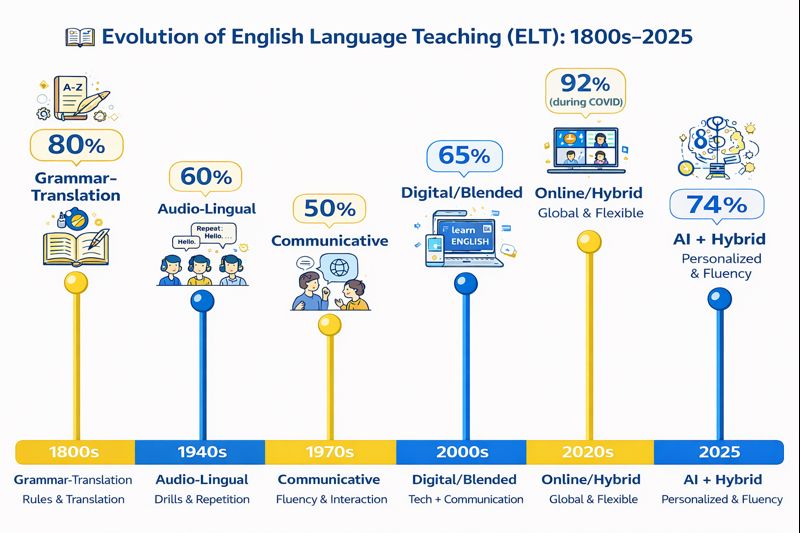
ELT Evolution at a Glance
- 1800s – Grammar-Translation (80% adoption)
- 1940s – Audio-Lingual Method (60% adoption)
- 1970s – Communicative Teaching (50% adoption)
- 2000s – Digital & Blended Learning (65% adoption)
- 2020s – Online & Hybrid Learning (92% during COVID)
- 2025 – AI + Hybrid Learning (74% weekly use)
Final Thoughts on the ELT Landscape in 2025
From dusty grammar books to AI chatbots, the evolution of teaching English shows how learning adapts to the world around it. In teaching English today, success comes from balancing pedagogy, technology, and human connection.
The ELT landscape in 2025 proves that English learning is no longer just about rules—it is about communication, confidence, creativity, and global connection.
Back to: The Complete Guide to ELT Teaching in 2025
Browse Our ELT Catalogue with up-to-date materials 😊 Nour E Sham Book Centre