
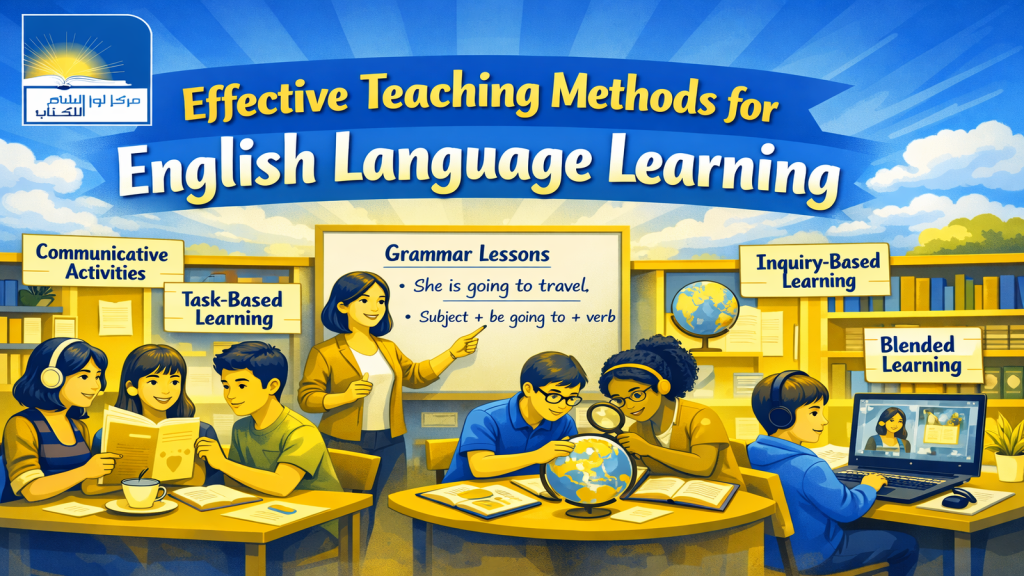
Modern ELT requires flexible, student-centered teaching methods that help learners use English confidently in real-life situations. The following approaches represent the most widely used and effective English teaching methods in 2025, with practical explanations teachers can apply immediately in the classroom.
Traditional vs. Modern English Teaching Methods
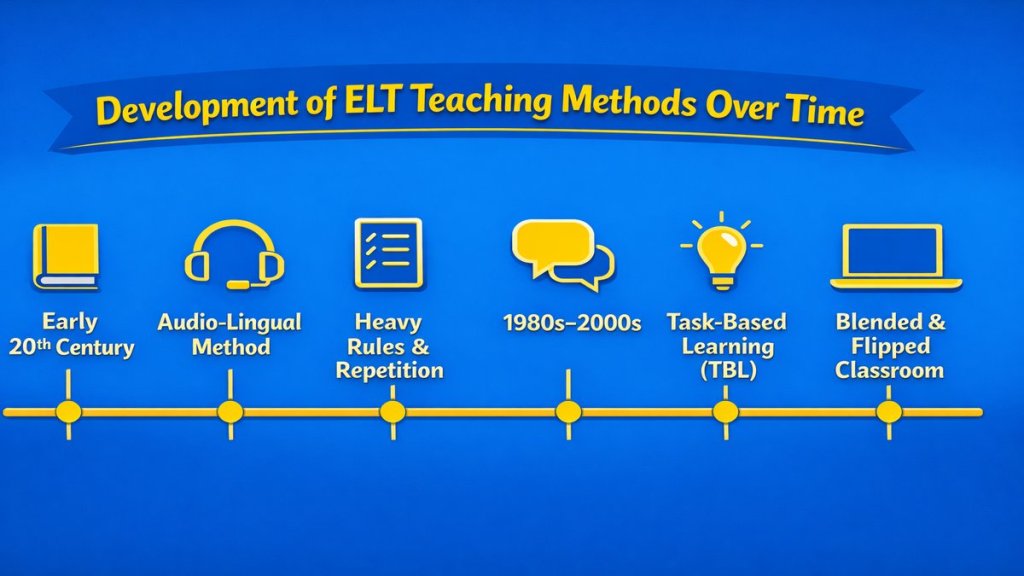
Understanding how ELT methods have developed over time helps teachers make informed choices based on their teaching context, learner needs, and lesson goals.
Traditional Teaching Methods (Still Useful, but Limited)
Grammar-Translation Method
Focus: Translating texts between English and the learner’s native language.
Classroom example: Students read a short English passage and translate it into their first language.
Strengths:
- Builds vocabulary knowledge
- Develops grammatical accuracy
Limitations:
- Minimal speaking and listening practice
Expert insight: ELT researchers note that while this method is outdated for communication-focused classrooms, it can still benefit exam-oriented learners who require high grammatical precision.
Audio-Lingual Method
Focus: Repetition, drills, and pattern practice through “listen and repeat” activities.
Classroom example: The teacher models a sentence (“I am walking to school”), and students repeat it multiple times.
Strengths:
- Improves pronunciation and sentence patterns
- Builds early speaking confidence
Limitations:
- Can feel mechanical and repetitive
Expert insight: Many beginner programs in East Asia continue to use audio-lingual drills as a foundation before introducing freer speaking activities.
Rule-Based, Teacher-Centered Instruction
Focus: Explicit grammar explanation followed by controlled practice.
Classroom example: The teacher explains verb tenses, then students complete worksheets.
Strengths:
- Clear structure
- Effective for exam preparation
Limitations:
- Low student engagement
- Limited communicative use of English
Modern English Teaching Methods (Core of ELT in 2025)
Communicative Language Teaching (CLT)
Key principles:
- Real-life communication
- Fluency before accuracy
- Pair and group work
- Authentic language use
Classroom example: Students role-play ordering food in a restaurant or solving a real-life problem together.
Why it works: CLT mirrors how language is used outside the classroom. Learners negotiate meaning, express ideas, and build confidence through interaction.
Expert insight: Penny Ur highlights that CLT helps students use English rather than simply know English.
Task-Based Learning (TBL)
Structure:
- Pre-task (introduce topic and key language)
- Task (students complete a meaningful activity)
- Language focus (reflection and feedback)
Classroom example: Learners plan a holiday trip together and present their ideas.
Benefits:
- High engagement
- Collaboration and critical thinking
- Natural communication
Best for: Teens and adults
Expert insight: Jane Willis explains that tasks push learners to communicate naturally, even with limited language.
PPP (Present–Practice–Produce)
Stages:
- Present new language
- Practice in controlled activities
- Produce language freely
Classroom example: Teaching “going to” for future plans, followed by guided practice and personal conversation.
Strengths:
- Easy to plan
- Clear structure for beginners
Limitations:
- Predictable
- Less effective for advanced learners
Expert insight: PPP remains popular with new teachers because it offers a clear and safe teaching framework.
Inquiry-Based Learning
Focus: Learning driven by curiosity, questions, and exploration.
Classroom example: Students research how people greet each other in different cultures and present their findings.
Benefits:
- Motivation and creativity
- Critical thinking development
Best for: Children and teenagers
Expert insight: Cambridge University Press specialists note that inquiry-based learning transforms classrooms into environments of discovery.
Concept-Based Learning
Focus: Teaching English through big ideas such as identity, community, or sustainability.
Classroom example:
Students explore the question “What makes a strong community?”, discuss global examples, and express personal opinions using new language.
Key benefits:
- Deep understanding and critical thinking
- Meaningful language use
- Learner autonomy and global awareness
Best for: Upper primary to teenage learners, especially in bilingual or international contexts.
Expert insight: Oxford University Press uses concept-based inquiry to help learners become autonomous thinkers and global citizens.
Blended Learning & Flipped Classrooms
Blended Learning: Combines online study with face-to-face lessons.
Flipped Classroom: Students learn new content at home and practice in class.
Classroom example: Learners watch a video lesson at home, then use class time for discussion and speaking.
Benefits:
- More speaking time
- Stronger communication focus
- Improved digital literacy
Which English Teaching Method Works Best for Your Classroom?
The most effective ELT approach depends on several factors:
- Age group:
- Kids → PPP, Inquiry-Based
- Teens → CLT, TBL, projects
- Adults → CLT, TBL, functional English
- Class size:
- Large classes → PPP, structured CLT
- Small classes → TBL, discussion-based lessons
- Learning goals:
- Exam preparation → PPP + CLT
- Fluency and confidence → CLT + TBL
- Teacher experience:
- New teachers → PPP, basic CLT
- Experienced teachers → TBL, inquiry-based learning
Section Summary
English language teaching in 2025 is communication-first and learner-centered. Effective teachers blend methods such as CLT, TBL, PPP, and inquiry-based learning to match learner needs, lesson goals, and classroom realities. When used thoughtfully, these approaches transform English lessons into engaging, meaningful learning experiences.
As Jeremy Harmer reminds us:
“No single method is perfect. The art of teaching is knowing when to mix and match.”
Back to: The Complete Guide to ELT Teaching in 2025
Up-to-date school books for ELT are here 😊 Nour E Sham Book Centre